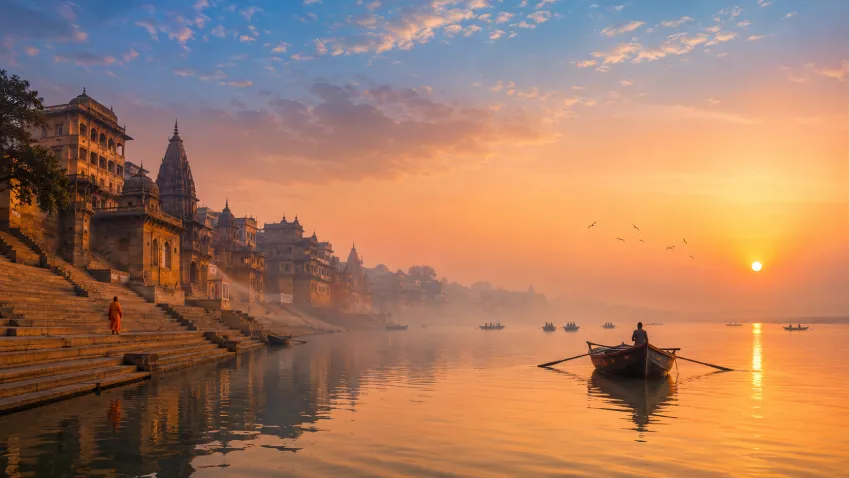
Long before Kashi Katha became part of ABHIRA, Varanasi had already begun to occupy a special place in the mind of Phalguni Mookhopadhayay, Founder-Chancellor of Brainware University.
His interest in Kashi grew through stories, family memories, mythology, music, literature, and accounts of a city where the sacred and the everyday have existed side by side for generations.
Among the stories he heard was the belief that Kashi rests upon the trident of Lord Shiva. Such accounts added to the city’s mystery, but they also raised a more practical curiosity.
What did Varanasi feel like beyond its legends?
What could be discovered by walking through its ghats, lanes, markets, temples, old houses, and ordinary neighbourhoods?
In 2019, Phalguni Mookhopadhayay travelled to Varanasi with a friend. The plan was simple: spend a week in the city without following a rigid itinerary.
That journey became the beginning of Kashi Katha.
Discovering Varanasi Through Its Streets
The first visit unfolded through walking.
There were no fixed routes to follow and no formal project to complete. The city revealed itself slowly through its ghats, narrow lanes, tea stalls, temples, markets, riverfronts, old buildings, and conversations with people whose lives were closely connected with Kashi.
Every encounter opened a different window into Varanasi.
A boatman understood the river through years of movement across it. A priest viewed the city through worship and ritual. A shopkeeper, musician, pilgrim, craftsperson, resident, or passer-by could reveal another layer of its everyday life.
What stood out most was the coexistence of different periods and experiences.
Ancient rituals continued beside motorcycles and mobile phones. Old houses stood inside busy neighbourhoods. Pilgrimage, trade, food, music, worship, labour, and domestic life occupied the same crowded spaces.
Varanasi did not appear as a city preserved only in the past. It was active, contemporary, intimate, unpredictable, and constantly changing.
One visit could not contain it.
Returning to Varanasi with a Camera
Phalguni Mookhopadhayay returned to Varanasi several times, carrying his camera with a clearer purpose.
The focus was not limited to famous temples, major ghats, or familiar postcard views. His photographs began recording the smaller details that often disappear between celebrated landmarks.
There was light falling across an old wall, a face at a tea stall, a boat resting beside the steps, food being prepared in a narrow lane, a forgotten doorway, a ritual beside the river, or a quiet moment inside a crowded neighbourhood.
Over the course of these journeys, he captured nearly 10,000 photographs.
Together, the images formed a visual archive of Varanasi as he had experienced it: through its people, architecture, faith, food, occupations, colours, textures, riverfronts, sounds, and silences.
This growing body of work became Kashi Katha.
What Is ABHIRA’s Kashi Katha?
Kashi Katha is an ABHIRA heritage storytelling project based on Phalguni Mookhopadhayay’s photographic journeys through Varanasi.
It is not intended to be a complete academic history of the city. Varanasi has already been studied through religious texts, historical research, literature, music, travel writing, photography, and cultural documentation.
Instead, ABHIRA’s Kashi Katha approaches the city as a pictorial scrapbook.
Through photographs and short narratives, the project invites readers to walk along the ghats, enter the maze of lanes, observe the architecture, meet the people, and experience the everyday rhythm of Kashi.
Each image begins with something witnessed during the journey: a person, a place, a ritual, a building, a conversation, or an ordinary moment carrying a larger story.
The project does not attempt to separate the sacred from the mundane. It records the way both exist together in Varanasi.
How Kashi Katha Became Part of ABHIRA
When ABHIRA, the Academy of Bharatiya Heritage Interpretation, Research & Advancement, was established as an initiative of Brainware University, Kashi Katha found a natural place within its work.
The project reflects the approach that defines ABHIRA: observe closely, document patiently, research responsibly, and communicate heritage in ways that remain accessible to wider audiences.
For ABHIRA, Varanasi is not only a sacred destination or a historic city. It is a living cultural landscape shaped by the Ganga, its ghats, architecture, music, food, crafts, rituals, occupations, residents, and visitors.
Through the vision of Phalguni Mookhopadhayay, a personal journey gradually became a wider heritage project.
What began as a week of unplanned exploration in 2019 eventually became thousands of photographs and an evolving visual record of Kashi.
That journey now continues through ABHIRA.
Frequently Asked Questions
What is ABHIRA’s Kashi Katha?
Kashi Katha is an ABHIRA visual heritage project based on Phalguni Mookhopadhayay’s journeys through Varanasi. It combines photography, cultural observation, personal encounters, and short-form storytelling.
Who initiated Kashi Katha?
Kashi Katha was initiated by Phalguni Mookhopadhayay, Founder-Chancellor of Brainware University, following his repeated photographic journeys through Varanasi.
What inspired Phalguni Mookhopadhayay’s interest in Varanasi?
His interest developed through stories of Kashi, family memories, mythology, music, literature, and curiosity about the city’s everyday cultural life.
When did the Kashi Katha journey begin?
The journey began with Phalguni Mookhopadhayay’s first visit to Varanasi in 2019 and continued through several later trips.
How many photographs are part of Kashi Katha?
Nearly 10,000 photographs were captured during Phalguni Mookhopadhayay’s visits to Varanasi.
How is Kashi Katha connected with ABHIRA?
Kashi Katha is part of ABHIRA’s work in heritage photography, cultural documentation, visual interpretation, and public storytelling.