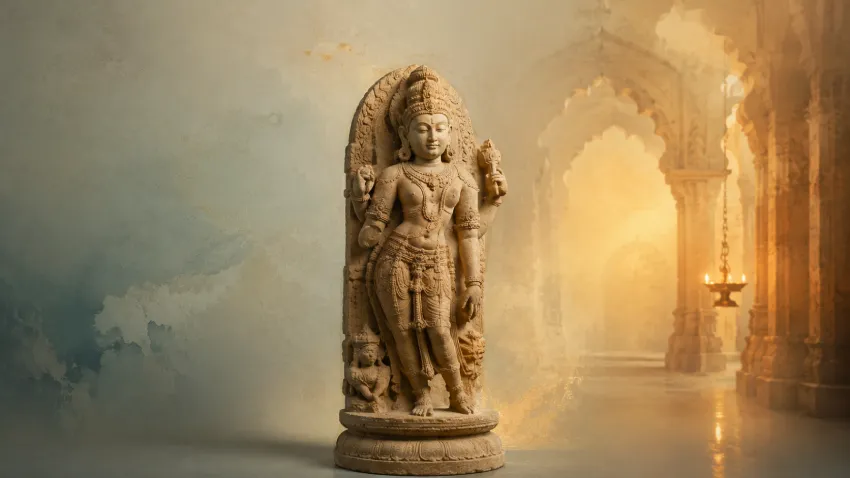
Most institutions begin with a formal proposal, a meeting, and a name written across a file.
ABHIRA began with a visit to a museum.
Inside the galleries of the Indian Museum, Kolkata, centuries of Indian history stood quietly in stone, bronze, terracotta, wood, and paint. Every sculpture had a label. Every artefact had a date, a place of origin, and an identity. Yet, for a visitor looking at these objects behind glass, one important part of the story was often difficult to imagine.
Where had this sculpture originally stood? What might have surrounded it? How would it have appeared when it was still part of a temple, settlement, ritual, or living community?
These were not abstract questions. They became the starting point of a practical visual experiment that would eventually lead to the formation of ABHIRA, the Academy of Bharatiya Heritage Interpretation, Research & Advancement, a Brainware University initiative dedicated to Indian heritage research, documentation, interpretation, and public storytelling.
A Visit That Started Something Larger
During a visit to the Indian Museum, Phalguni Mookhopadhayay, Founder-Chancellor of Brainware University, photographed a number of sculptures and artefacts displayed in its galleries.
He was already deeply involved in photography, filmmaking, digital art, music, and cultural projects. Looking at the museum objects through the eye of a photographer and storyteller, he began thinking about how they could be presented beyond conventional documentation.
The intention was not to alter the artefacts or invent stories around them. It was to help viewers understand their possible historical settings.
A sculpture displayed against a plain museum wall may once have occupied the central space of a temple. A carved architectural fragment may have belonged to a much larger structure. A deity now seen as an isolated stone figure may originally have been surrounded by worshippers, lamps, pillars, music, ritual objects, and other sculptures.
Could research, filmmaking, digital art, and responsible artificial intelligence help viewers see some of that lost context?
This question brought together a small team of researchers, writers, visual artists, designers, filmmakers, and AI practitioners at Brainware University.
The first experiments began.
Bringing an Artefact Back into Its World
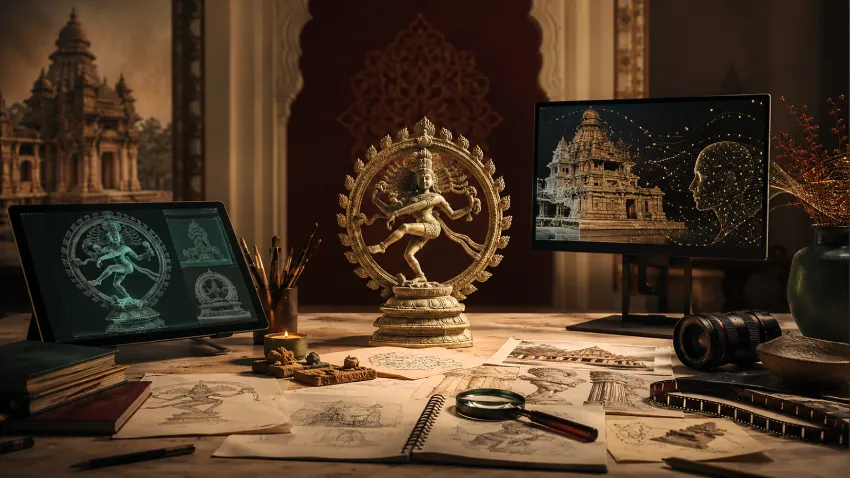
The team started studying the photographed objects closely.
The inscriptions, museum descriptions, historical periods, materials, regional styles, iconography, architecture, clothing, landscape, and ritual context associated with each artefact had to be considered. The purpose was not simply to create visually attractive images. The surrounding world had to remain historically believable.
A museum sculpture, for example, could not be placed inside a random “ancient Indian” background.
Its century mattered. Its region mattered. The architectural material mattered. The position of the deity mattered. The surrounding figures, symbols, pillars, weapons, ornaments, and gestures mattered.
Researchers collected information. Writers developed interpretations. Visual artists reconstructed settings. Filmmakers considered movement, light, sound, and sequence. AI tools assisted the creative process, but each visual was shaped and reviewed by people.
Gradually, the artefacts appeared to move beyond their display cases.
A figure that had been standing alone could now be viewed inside a possible architectural setting. A broken fragment could be connected visually with the kind of structure from which it may have originated. A sculpture could be seen not only as a museum object, but as something that had once belonged to a living cultural world.
This research-led visual project came to be known as Back to the Past.
The Birth of “Back to the Past”
Back to the Past was developed as a visual journey through selected artefacts and historical periods represented in the Indian Museum’s collections.
The project combined museum-based learning with historical research, visual interpretation, film production, digital reconstruction, and responsible AI. Its objective was simple: to help the general public understand how museum artefacts may have existed within their original environments.
The early visual sequences developed by the Brainware University team demonstrated that heritage communication could be academically grounded and visually engaging at the same time.
The work attracted the attention and encouragement of Dr. Sayan Bhattacharya, Director of the Indian Museum. What had begun as a creative experiment was now seen as something that could grow into a sustained platform for heritage research, interpretation, education, and public engagement.
The discussion moved beyond the production of a single film.
There was now a need for a dedicated centre that could bring historians, museum professionals, researchers, artists, filmmakers, writers, students, designers, technologists, and cultural institutions together.
That idea became ABHIRA.
Frequently Asked Questions
What is the full form of ABHIRA?
ABHIRA stands for the Academy of Bharatiya Heritage Interpretation, Research & Advancement. It is a heritage initiative of Brainware University focused on research, documentation, interpretation, and public storytelling.
How did ABHIRA begin?
ABHIRA began with a visit to the Indian Museum, Kolkata, where Phalguni Mookhopadhayay photographed selected sculptures and artefacts. His effort to imagine these objects within their possible original historical settings led to a research-led visual experiment that eventually developed into ABHIRA.
Who initiated the idea behind ABHIRA?
The idea behind ABHIRA was initiated by Phalguni Mookhopadhayay, Founder-Chancellor of Brainware University. His interest in photography, filmmaking, digital art, music, and cultural documentation shaped the project’s early direction.
What inspired the formation of ABHIRA?
ABHIRA was inspired by a question raised while viewing artefacts inside the Indian Museum: how might these sculptures and fragments have appeared within their original temples, settlements, rituals, and cultural environments?
What is Back to the Past?
Back to the Past is a research-led visual heritage project that reconstructs possible historical settings around selected artefacts from the Indian Museum’s collections. It uses historical research, visual interpretation, filmmaking, digital reconstruction, and responsible artificial intelligence.
How did Back to the Past lead to ABHIRA?
Back to the Past showed that heritage could be presented in a way that was both academically grounded and visually engaging. The project revealed the need for a dedicated centre where researchers, museum professionals, writers, filmmakers, artists, designers, students, and technologists could work together. That idea became ABHIRA.
What role did the Indian Museum play in the origin of ABHIRA?
The Indian Museum, Kolkata, provided the setting and collections that inspired the original visual experiment. The encouragement of Dr. Sayan Bhattacharya, Director of the Indian Museum, also helped the project grow from a creative exercise into the idea of a sustained heritage platform.
How were the artefacts visually reconstructed?
The Brainware University team studied museum descriptions, inscriptions, historical periods, materials, regional styles, iconography, architecture, clothing, landscapes, and ritual contexts. These details were used to create historically believable interpretations of the environments in which the artefacts may once have existed.
Did ABHIRA use artificial intelligence in its early work?
Yes. Artificial intelligence assisted parts of the visual reconstruction process, but it did not replace human research or judgement. Researchers, writers, visual artists, designers, and filmmakers reviewed and shaped every visual interpretation.
Was the purpose of the project to alter museum artefacts?
No. The purpose was not to alter the artefacts or invent fictional stories around them. The aim was to help viewers understand the possible historical, architectural, and cultural settings to which the objects once belonged.
Why was a dedicated centre like ABHIRA needed?
A dedicated centre was needed to bring heritage research, museum knowledge, storytelling, filmmaking, design, and responsible technology together. ABHIRA emerged as a platform for developing this work beyond a single film or visual experiment.