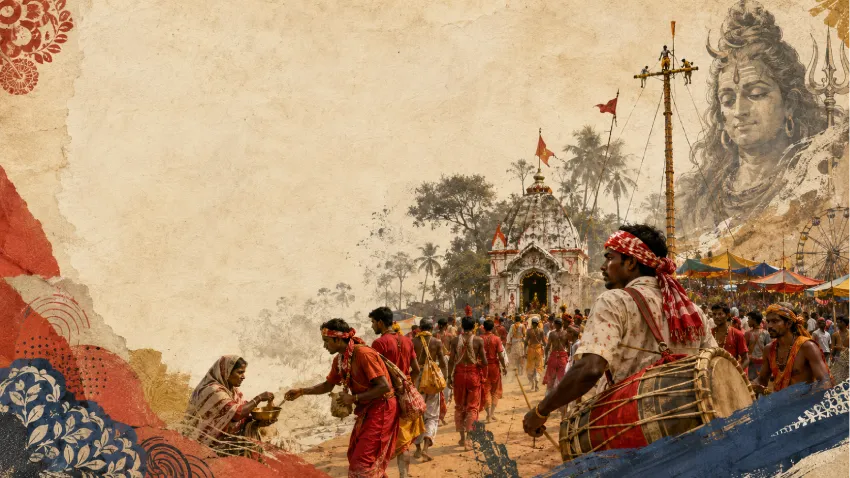
In the final days of Chaitra, when the Bengali year is almost over, drums begin to sound across many villages of Bengal. Devotees in red or saffron move from house to house collecting alms. Temporary fairs appear beside local shrines. Processions fill the roads, and familiar villagers take on the role of sannyasis for a few days.
This is Gajan, one of Bengal’s most distinctive folk festivals.
What Is the Gajan Festival?
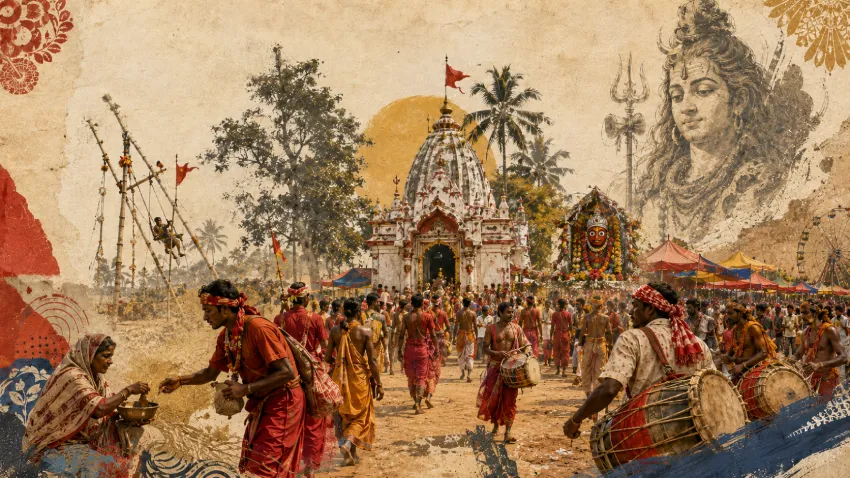
Gajan is a seasonal religious festival most commonly associated with Lord Shiva, although important traditions are also dedicated to Dharmathakur. Shiva Gajan usually reaches its climax on Chaitra Sankranti, the final day of the Bengali calendar, immediately before Poila Baishakh. Dharma Gajan may follow a different lunar schedule, which is one reason celebrations vary from village to village.
There is no single rulebook followed everywhere. Its songs, vows, processions, performances and rituals have largely survived through community practice and oral transmission. Local forms can therefore differ greatly.
A Festival Shaped by Village Life
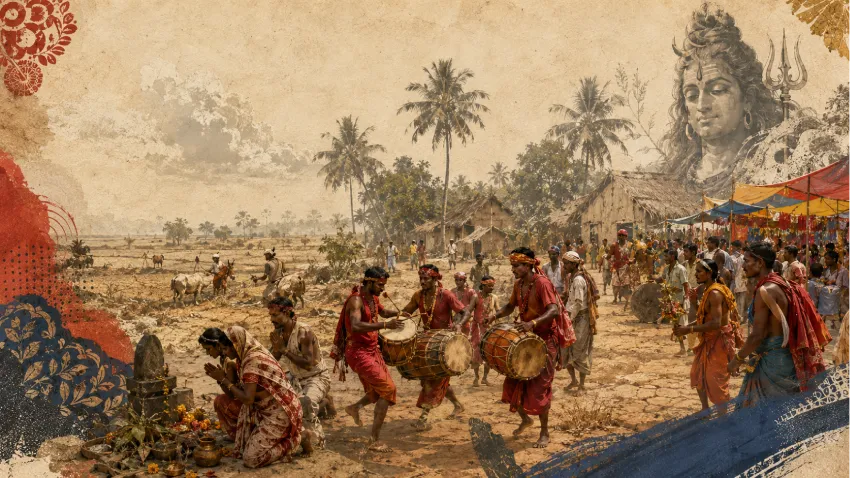
Gajan is closely connected with rural society and the agricultural calendar. It arrives at a seasonal threshold: the old year is ending, summer is intensifying, and cultivators are waiting for rain and the next cycle of crops.
The festival carries collective prayers for health, rain, fertility, protection and prosperity. It is not limited to private worship. The wider village joins through music, performance, trade, worship and the fair. Scholars studying Gajan have consequently described it as a major festival of village Bengal, shaped particularly by communities historically situated outside the centre of Brahmanical ritual authority.
The Shiva of Gajan also has a distinctly Bengali character. In folk songs and short plays, he is not always the distant god of Mount Kailash. He may appear as a poor householder, an idle husband scolded by Parvati, or a village figure familiar with hunger, work and family troubles. This accessible Shiva helps explain Gajan’s deep connection with ordinary rural communities.
Who Are the Gajan Sannyasis?
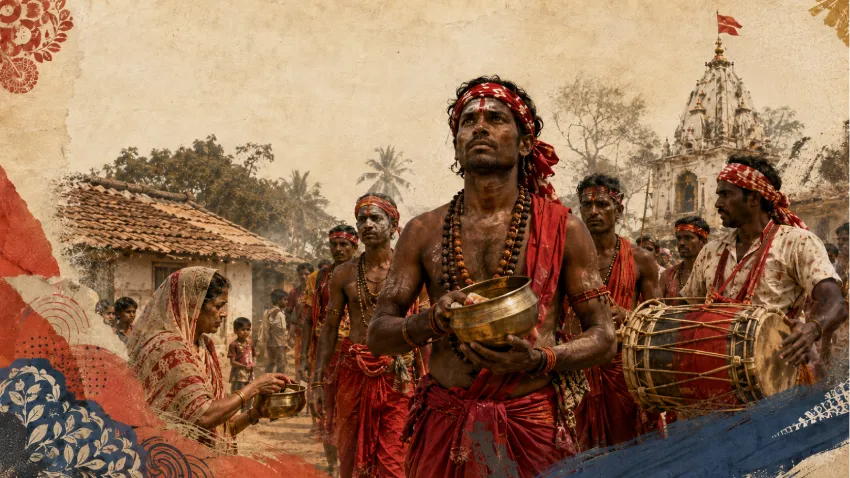
The principal participants are called Gajan sannyasis, bhaktas or devotees. Their renunciation is temporary. During the festival, they may fast, follow dietary rules, wear ritual clothing, collect alms, avoid ordinary comforts and submit to group discipline.
During Gajan, people who may occupy modest positions become its central ritual actors. Their bodies become offerings through fasting, sleeplessness, dancing, long processions and, in some traditions, demanding physical acts.
Fire-walking, thorn rituals, piercing and other forms of bodily penance have historically appeared in some local celebrations. Yet these spectacles are only one part of Gajan. The festival also includes songs, comic performances, folk theatre, mythological costumes, communal gatherings and village fairs.
Is Gajan the Same as Charak Puja?
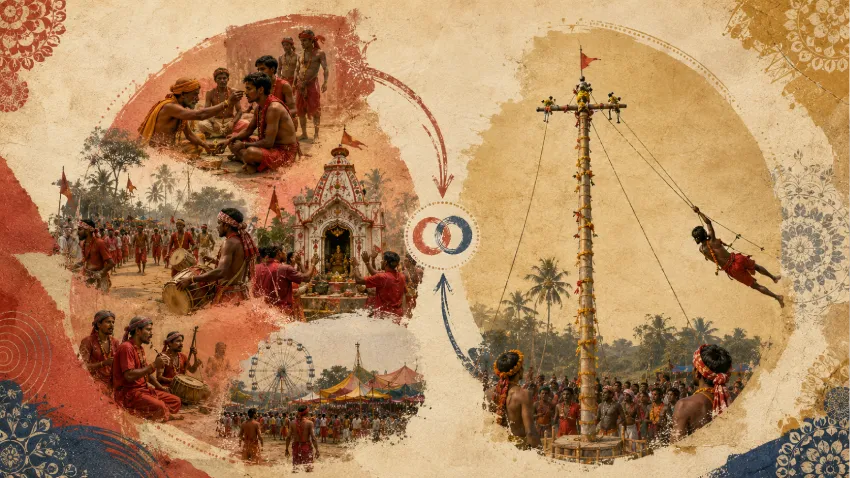
Gajan and Charak Puja are closely connected, but they are not identical.
Gajan refers to the wider cycle of vows and ceremonies. Charak is generally its concluding and most visible ritual, performed on Chaitra Sankranti. Traditionally, a tall wooden pole known as the Charak tree is erected, and devotees circle or are swung around it as an act of penance. Its spectacle often overshadows the quieter rituals that precede it.
Other observances may include fasting, sacred-thread rituals, fruit offerings and Nila Puja, which represents the ceremonial marriage of Shiva and Nilavati. Their order and form depend on local custom.
The Many Histories Within Gajan
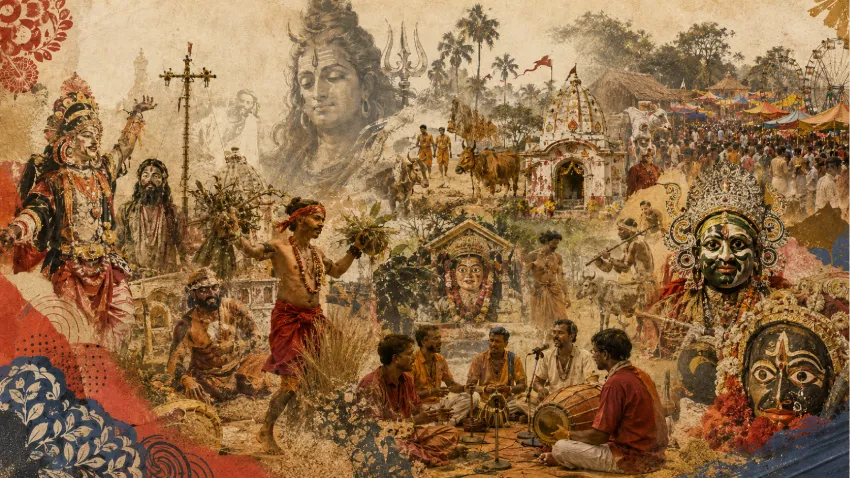
Gajan cannot be explained through one origin story. Scholars connect it with Shiva worship, the older cult of Dharmathakur, seasonal fertility rites, and the long interaction between local Bengali beliefs and Brahmanical traditions. Some researchers consider Dharma Gajan to preserve particularly old layers of Bengal’s religious culture, although the history remains a subject of interpretation rather than a settled conclusion.
That layered past remains visible. Shiva and Dharma shrines may stand close together. Sanskrit prayers may coexist with village songs. Devotion shares space with satire, theatre, costumes and the crowded mela.
Gajan survives because communities remember its songs, organise its rituals and pass its practices across generations. For ABHIRA, the festival shows how Bengal’s heritage lives not only in monuments and manuscripts, but also in seasonal memory, oral traditions and collective participation.
Frequently Asked Questions
When is Gajan celebrated in West Bengal?
Shiva Gajan is generally celebrated during the final days of Chaitra and culminates on Chaitra Sankranti, just before Poila Baishakh. Dates and duration may vary locally.
Which deity is worshipped during Gajan?
Most Gajan festivals honour Shiva, while several regions observe Dharma Gajan in honour of Dharmathakur.
What is the difference between Gajan and Charak Puja?
Gajan is the broader festival of vows, processions and rituals. Charak Puja is usually its concluding and most widely recognised public ceremony.
Why do devotees become Gajan sannyasis?
Devotees temporarily renounce ordinary comforts and follow ritual discipline as an expression of faith, penance and prayer for community wellbeing.
Why is Gajan important to Bengali culture?
Gajan preserves Bengal’s folk worship, agricultural memory, oral traditions, local performances, village fairs and community participation.